How can AI help us understand and predict a changing planet?
We use machine learning, remote sensing, flood mapping, weather forecasting, and data reconstruction to turn multi-source Earth observations into interpretable climate insight.
Why it matters
A changing planet produces data that are large, uneven, and noisy. AI is useful when it improves reconstruction, detection, attribution, and prediction while staying tied to physical evidence.
Topic
AI for Earth twins
Our contributions
- Build AI-enabled Earth representations from reservoir LiDAR monitoring, SAR-optical water-surface solar inventories, AlphaEarth cropland maps, evapotranspiration data, and global wind-speed products.
- Use high-resolution mapping and dataset outputs to connect physical Earth-system processes with digital twin-style monitoring and prediction.
Paper
 Featured
 our team
 Latestour team
Global instantaneous monitoring of reservoir water levels using ICESat-2 photon-counting LiDAR
Representative outputs
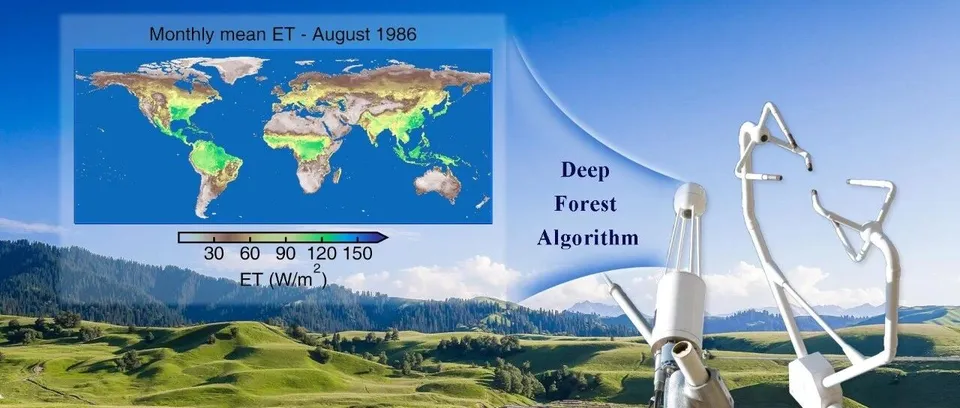
Global evapotranspiration (WB-MTE)
A global monthly evapotranspiration dataset at 0.5 degree resolution from 1982 to 2009, built by coupling a water balance model with machine learning.
GGWS-PCNN global wind speed
A global gridded monthly wind speed dataset using partial convolutional neural networks, HadISD observations, and 34 climate models for 1973-2021.
Related news
AI for energy
Our contributions
- Apply AI and data-driven assessment to renewable-energy questions spanning ocean-energy heatwave risk, wind-speed products, floating solar, photovoltaic siting, and desalination systems.
- Connect Greater Bay Area offshore-wind forecasting, GGWS-PCNN global wind speed, and floating-solar outputs to support energy-system decisions under climate change.
Paper
Representative outputs
GGWS-PCNN global wind speed
A global gridded monthly wind speed dataset using partial convolutional neural networks, HadISD observations, and 34 climate models for 1973-2021.
Floating solar power
Code resources for assessing energy production and water savings from floating solar photovoltaics on global reservoirs.
气候变化背景下的粤港澳大湾区海上风能资源评估与预测
评估并预测气候变化背景下粤港澳大湾区海上风能资源。
AI for weather
Our contributions
- Develop weather-focused AI and monitoring evidence across short-duration precipitation, typhoon rainfall patterns, sandstorms, downburst services, drought events, and wind estimation.
- Connect marine meteorology and ecological-disaster monitoring outputs with data-driven and dynamical downscaling approaches for short-term weather risk assessment.
Paper
Representative outputs
海洋气象信息与生态灾害一体化监测预警技术研究及应用示范
面向海洋气象信息与生态灾害,开展一体化监测预警技术研究与应用示范。
AI for climate
Our contributions
- Use interpretable AI, AlphaEarth cropland mapping, urban carbon-flux analysis, marine heatwave diagnosis, and subgrid vegetation studies to improve climate-risk understanding.
- Connect evapotranspiration and GGWS-PCNN wind-speed datasets with climate prediction, climate-change detection, and Earth-system model evaluation.
Paper
Representative outputs
Global evapotranspiration (WB-MTE)
A global monthly evapotranspiration dataset at 0.5 degree resolution from 1982 to 2009, built by coupling a water balance model with machine learning.
GGWS-PCNN global wind speed
A global gridded monthly wind speed dataset using partial convolutional neural networks, HadISD observations, and 34 climate models for 1973-2021.